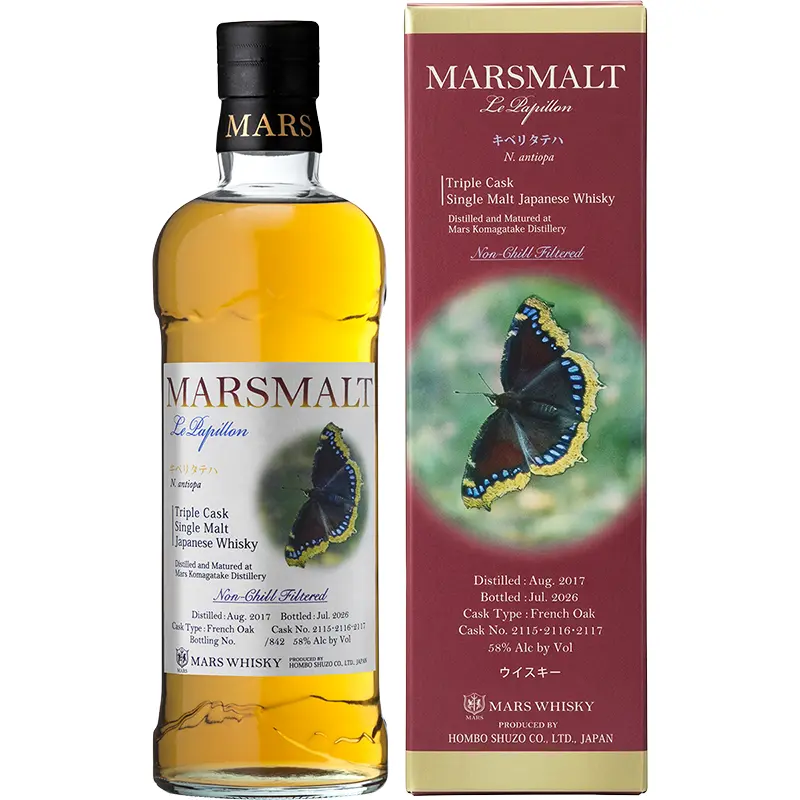


A masterpiece of a triple-cask single malt whisky, blended from malt spirits aged in French oak barrels
“Mars Malt Le Papillon” is a series that uses butterflies native to Japan as motifs to express the splendor of the natural environment and the ever-changing climate of Japan’s four seasons, which shape the whisky’s maturation environment.
The motif for this expression is the “Nymphalis antiopa,” which inhabits broadleaf forests on Honshu primarily at elevations of 1,500 to 2,500 meters.
With the outer edges of its wings edged in yellow and a row of lapis-blue markings inside—a beauty so elegant it is also known as the “Lady of the Highlands”—this triple-casksingle malt whisky.
1. Mars Malt Le Papillon Triple Cask “Nymphalis antiopa”

2. Product Specifications
| Alcohol Content | 58% |
| Type | Single Malt Japanese whisky |
| Cask Type | French oak casks (Cask Nos.: 2115, 2116, 2117) |
| Volume | 700 ml |
| Number of Bottles Sold | 842 bottles |
| Suggested Retail Price | 15,400 yen (tax included) |
| Origin of Ingredients | Produced in Japan (Malt whisky) |
| Year of Distillation | August 2017 (Bottled: July 2026) |
| Maturation Location | Mars Komagatake Distillery |
| Distillery | Mars Komagatake Distillery |
The Nymphalis antiopa is also known as the “Lady of the Highlands” due to its elegant appearance.
When I was in elementary school, I used to spend my summer vacations with my grandmother in Shinshu, but this was a rare sighting—I’d only come across it once or twice a summer.
My first encounter was at the site of a campfire in a corner of the garden. I still can’t forget the overwhelming sense of its bulk as it thrashed about inside the net.
Eventually, I came to realize that this butterfly only appeared in the latter half of summer.
Yes, encountering this butterfly I’d longed to see also signaled the end of a summer vacation that, in some ways, felt like it would last forever.
Perhaps I grew up a little thanks to this “Lady of the Highlands,” who stirred such complex emotions within me.
A triple-cask single malt whisky reminiscent of the “Highland Lady,” created by selecting and blending three barrels of malt spirit distilled in 2017 at the Mars Komagatake Distillery and aged in French oak barrels.
Photos and Text by Shuichi Ogino
3. Manufacturer
Hombo Shuzo Co., Ltd.
| Established | 1872 |
| Headquarters Address | 3-27 Minami-Sakae, Kagoshima City, Kagoshima Prefecture 891-0122 |
| Distilleries Owned | Mars Komagatake Distillery, Mars Tsunuki Distillery |
4. About the Mars Komagatake Distillery
The distillery was formerly known as the “Mars Shinshu Distillery,” located in Miyata Village, Nagano Prefecture.
and has been renamed the “Komagatake Distillery” as of March 2024.
| Distillery Name | Mars Komagatake Distillery |
| Address | 4752-31 Miyatamura, Kamiina-gun, Nagano Prefecture 399-4301 |
| Start of Operations | 1985 |
In 1949, Hombo Shuzo—which had been dedicated to producing the Japanese distilled spirit “shochu” in Kagoshima—obtained a license to produce whisky. Since then, the company had continued to harbor the dream of “one day creating authentic whisky that makes the most of Japan’s climate and terroir.”
A few years after beginning whisky production in Kagoshima, the company established “Mars Yamanashi Winery” in Yamanashi in 1960 as a facility for producing both wine and whisky. Then, in order to devote itself fully to whisky production, the company set out to find an even more ideal location.
The natural conditions required for whisky production are extremely demanding: the region must be a cold area with crisp, clear air, yet also blessed with moderate humidity and high-quality water.In search of a location that met these conditions, Mars Shinshu Distillery was established in 1985 at an elevation of 798 meters at the foot of Mount Komagatake in the Central Alps of Nagano Prefecture—an environment ideal for whisky production.
In 1992, distillation was suspended due to sluggish demand for whisky . Later, as Japanese whisky began to gain recognition worldwide and demand for whisky showed signs of recovery , we decided to resume distillation in 2009 and restarted operations in February 2011.
In September 2020, the distillery underwent a complete renovation for the first time in 35 years, with an investment of approximately 1.2 billion yen.
Starting in May 2019, with the goal of renovating aging equipment, expanding barrel storage facilities to accommodate increased whisky production, and providing tours of the whisky-making process, the distillery complex (including the barrel storage facility) was renovated. Additionally, a new visitor center was constructed to sell original whiskys and merchandise.and existing equipment and facilities were renovated.
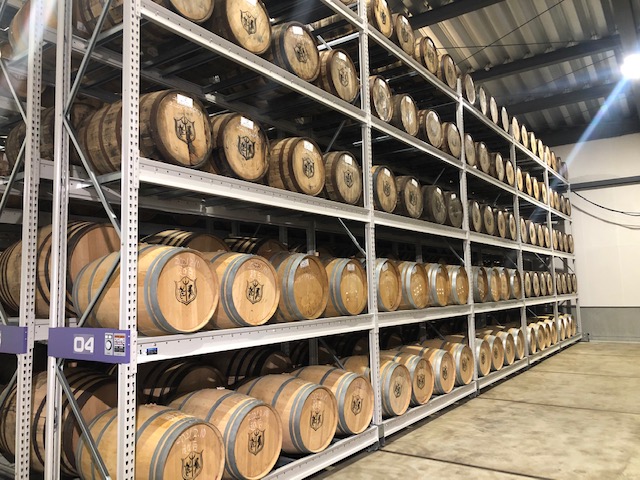
The newly constructed whisky distillery building covers 1,996 square meters (gross floor area, including a barrel storage facility designed to hold approximately 2,500 barrels), while the visitor center covers 746 square meters.
Source: Hombo Shuzo Official Website
■ Production Capacity: 1.1 metric tons of malt per day
■ Raw Spirit Production: Approx. 700 L/day, approx. 185 KL/year (planned for fiscal year 2020)
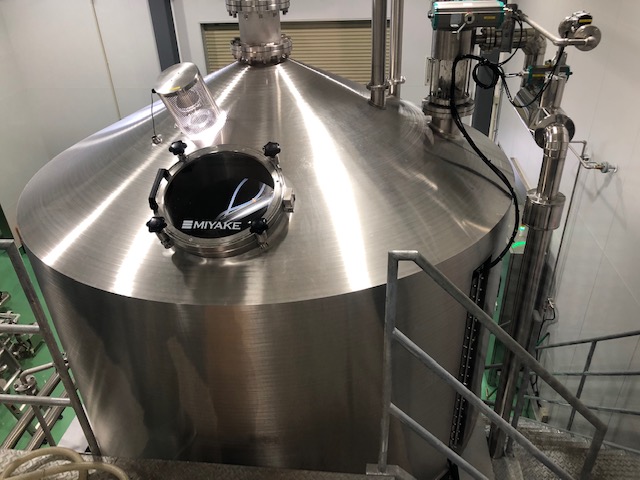
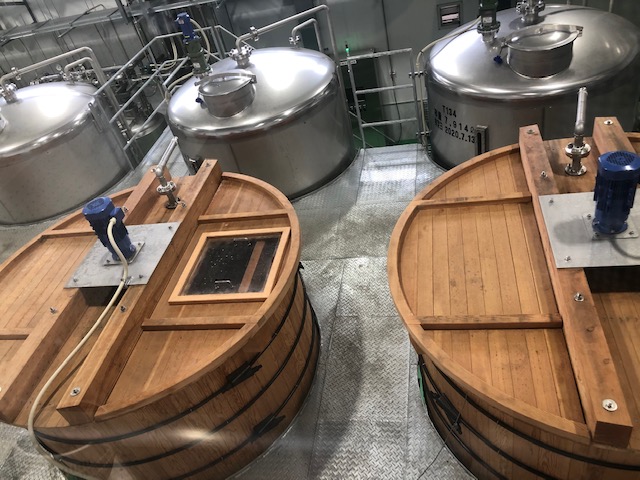
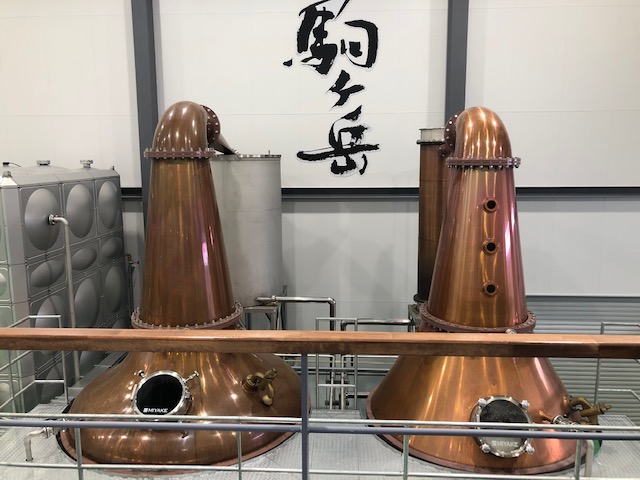
■ Major Equipment: 1 malt mill, 1 6 KL mash tan roitel (saccharification tank), 3 6 KL stainless steel fermentation tanks, 3 6 KL Douglas fir fermentation tanks (relocated), and a first-distillation still (relocated)
 |
 |
 |
 |
Please also see the information on the Mars Komagatake Distillery below ↓.


5. Summary
This marks the 22nd release in the Papillon Series.
This Triple Cask release features three consecutive French oak casks.
Highly recommended for those who enjoy vanilla aromas and refined spice notes such as nutmeg and cloves.
6. Raffle Site

Lastly: Recommended Books on Japanese Whisky
If you want to learn more about Japanese whisky, which is a global trend, we highly recommend these books.
(1).Whisky Galore Vol.29 December 2021 issue
In the December 2021 issue of Whisky Galore, published by the Whisky Culture Research Institute, we report on 11 Japanese craft distilleries, including some that are open to the public for the first time, under the title of “Japanese Whisky Craft Frontline,” the first of three consecutive issues. Why did the popularity of Japanese whisky and the craft boom occur? We will examine with interviews. Chichibu Distillery / Chichibu No.2 Distillery / Mars Shinshu Distillery / Mars Tsunuki Distillery / Kanosuke Distillery / Hioki Distillery / Ontake Distillery / Osuzuyama Distillery / Kaikyo Distillery / Hanyu Distillery / Konosu Distillery


(2). Japanese Whisky as an Education for Business
This is a book written by Mamoru Tsuchiya, a world-famous whisky critic and representative of the Whisky Culture Research Institute, titled “Japanese Whisky as a Culture that Works for Business” .
The book covers the basics of whisky, the introduction of whisky to Japan, the birth of Japanese whisky, advertising strategies and the rise of Japanese whisky, and the current rise of craft distilleries. This is a book that summarizes Japanese whisky in a very easy to understand way.

(3). Whisky and I (Masataka Taketsuru)
Masataka Taketsuru, the founder of Nikka Whisky, devoted his life to brewing whisky in Japan. This is a revised and reprinted version of the autobiography of a man who simply loved whisky and talked about himself. The book vividly depicts the days when he went to Scotland alone to study as a young man and overcame many hardships to complete Japanese whisky, as well as his companion, Rita.
(4). A Letter of Challenge from a New Generation Distillery
Launching in 2019. With the world experiencing an unprecedented whisky boom, what were the managers of craft distilleries thinking and what were their thoughts as they took on the challenge of making whisky? This book tells the stories of 13 craft distillery owners, including Ichiro Hido of Venture Whisky, famous for his Ichirose Malt, who inspired the birth of craft distilleries in Japan.
(5). Whiskey Rising
This is the Japanese version of Whisky Risng, published in the US in 2016, with much updated content. Not only does it describe the history of Japanese whisky in detail, but it also includes data on all the distilleries in Japan, including the craft distilleries that have been founded in recent years. The book also includes descriptions of the legendary bottles that have been released, as well as information on bars where Japanese whisky can be found.